INTRODUCTION
What is liquid penetrant testing (LPT)?
Liquid Penetrant Testing (or Dye Penetrant Inspection) is one of the most widely used non-destructive testing (NDT) methods. It is based on capillarity, where a liquid flows into narrow spaces without the need for external force, even against gravity. The processes and materials involved are designed to make this capillary action visible and interpretable. LPT is highly effective for detecting surface discontinuities, including those not visible to the naked eye.
Liquid penetrant testing (LPT) detects open surface-breaking discontinuities (cracks, porosity, lack of fusion, fatigue cracks, stress corrosion cracking (SCC), and hydrogen-induced cracking (HIC)) across metallic, ceramic, and non-porous composite materials. Applicable to ferromagnetic and non-ferromagnetic substrates alike, LPT is one of the most operationally flexible surface inspection methods available across the full asset lifecycle: manufacturing, in-service operation, and scheduled maintenance.
How does liquid penetrant testing work? Standard procedure and applicable codes
The LPT procedure is standardized under several standards (e.g., ASME, ASTM, API, ISO, etc.). Applus+ executes the following six-stage sequence on every inspection:
1. Surface preparation: Removal of contaminants that could obstruct penetrant entry or generate false indications. Method selected per substrate and applicable procedure.
2. Penetrant application and dwell: Fluorescent or visible dye penetrant applied to the surface. Minimum dwell times are defined by sensitivity level and temperature, as specified in the used standard.
3. Excess penetrant removal: Water-washable, solvent-removable, or post-emulsifiable method selected per procedure. The removal technique directly affects sensitivity.
4. Developer application: White developer draws residual penetrant from discontinuities to the surface by reverse capillary action, producing a visible indication against the developer background.
5. Examination: Indications evaluated under UV-A light (fluorescent) or white light (visible dye) against acceptance criteria defined by the standards.
6. Post-cleaning: Surface cleaned after examination to remove developer and residual penetrant in accordance with procedure requirements.
Applus+ liquid penetrant testing capabilities
Applus+ uses only top-quality products from leading suppliers such as Sherwin and Magnaflux. We also have laboratories available for testing parts shipped to our facilities. Our procedures are fully compliant with ASNT, ASTM, and ISO standards. We have Level III-certified technicians who provide technical support and guidance and develop new procedures as needed.
All Applus+ LPT procedures are developed and qualified by Level III-certified technicians under the ASNT SNT-TC-1A, ISO 9712, and NAS 410 qualification schemes. Procedures comply with ASTM E1417, ASTM E165, ASME BPVC Section V Article 6, ASME B31.1, ASME B31.3, API 510, API 570, and client-specific requirements. Field inspection teams are deployable across Oil & Gas, petrochemical, aerospace, and power generation assets in more than 70 countries where Applus+ operates.
Which liquid penetrant testing method applies to your inspection requirement?
Method selection depends on sensitivity requirements, inspection environment, and the applicable code. Applus+ evaluates each case individually. The following table provides a reference framework:
| Inspection challenge |
Recommended LPT method |
Applicable standard |
| Weld surface inspection - field conditions |
Visible Dye Penetrant (Type II) |
ASTM E1417 / ASTM E165 / AWS D1.1 |
| Aerospace components - maximum sensitivity |
Fluorescent Penetrant (Type I, Level 3-4) |
ASTM E1417 / BAC 5423 / AMS 2647 |
| In-service fatigue cracks, SCC, HIC - pipelines and pressure vessels |
Fluorescent or Visible Dye - per site access |
ASME BPVC Section V Art. 6 / API 510 / API 570 |
| Power generation - turbine blades, pressure equipment |
Fluorescent Penetrant (Type I) |
ASME BPVC Section V Art. 6 |
Industries and applications
LPT is used to detect and evaluate surface defects throughout an asset's lifecycle, including surface-breaking manufacturing flaws such as cracks, lack of fusion, porosity, inclusions, hot tears, and gas holes. It also detects in-service discontinuities, such as fatigue cracks, HIC, SOHIC, and SCC. Early detection enables better outage planning and avoids emergency interventions. This method is used across industries, including aerospace, food processing, power generation, oil/mining production and refining, maritime, and more.
Benefits of liquid penetrant testing
LPT (Liquid Penetrant Testing) services are cost-effective and highly reliable for detecting surface-level discontinuities. It enhances product integrity, enables early detection of flaws, and helps reduce operational downtime. By ensuring compliance with quality standards, Applus+ helps clients minimize risk and improve overall efficiency.
- Material versatility: applicable to ferromagnetic and non-ferromagnetic metals, ceramics, and non-porous composites. Unlike Magnetic Particle Inspection (MPI), LPT is not restricted to ferromagnetic substrates.
- Operational flexibility: visible dye penetrant requires no specialist equipment, enabling deployment on in-service assets, remote pipelines, and offshore installations without process interruption.
- High sensitivity: fluorescent penetrant systems achieve sensitivity Level 4 per ASTM E1417, detecting surface-breaking discontinuities not identifiable under standard white-light conditions.
- Code compliance: procedures qualified to ASTM E1417, ASTM E165, ASME BPVC Section V, API 510, API 570, ISO and AWS D1.1. Reports accepted for regulatory audits, equipment recertification, and integrity reviews.
- Real-time results: indications assessed during the inspection campaign; preliminary field reports issued immediately upon identification of anomalies requiring urgent assessment.
LPT techniques: fluorescent penetrant inspection and visible dye penetrant
Applus+ deploys both fluorescent and visible dye penetrant methods. Sensitivity requirements, operational environment, and the applicable inspection code govern method selection.
Fluorescent Penetrant Inspection
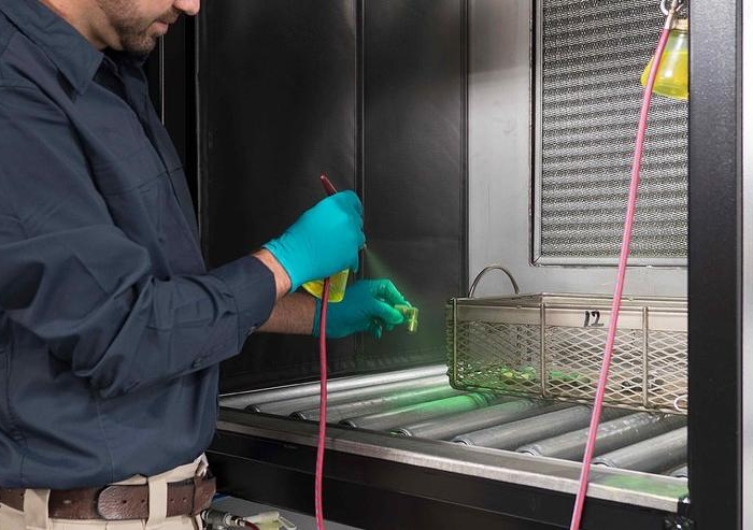
NDT penetrant testing includes fluorescent dye penetrant, which is typically green and uses a white developer to draw the dye back to the surface from within discontinuities via 'wicking' or capillary action. The fluorescent penetrant emits visible light when excited by UV-A light and can be used on a variety of materials. A fluorescent penetrant is typically more sensitive than a visible dye and is ranked into 4 levels of sensitivity. It does, however, require special lighting conditions: NDT penetrant technicians must have UV-A lamps, blackout shades, and on-site power generators. Fluorescent-dye testing is easily performed under laboratory conditions.
Fluorescent penetrant inspection is the standard method for aerospace components (BAC 5423, AMS 2647), turbine blades, and safety-critical applications requiring maximum sensitivity. Sensitivity Levels 3 and 4, as specified in ASTM E1417, are typically specified for aerospace and high-consequence components.
Visible Dye Penetrant
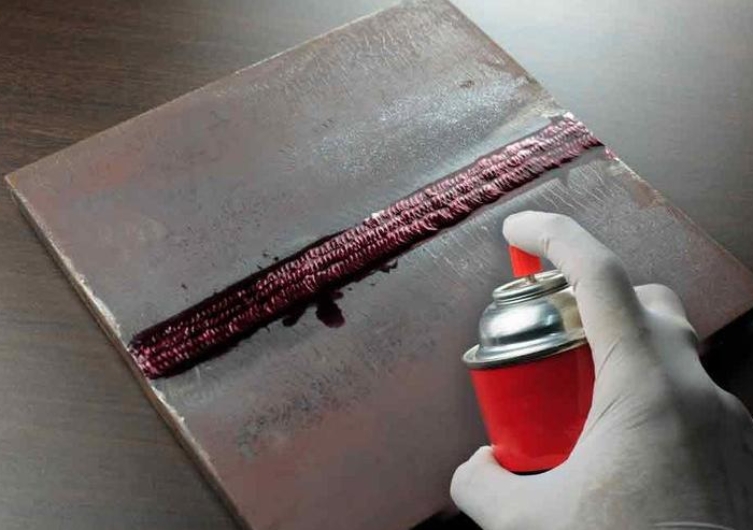
Visible-dye penetrant is an NDT method that typically uses a red dye and a white developer to draw the dye back to the surface from within discontinuities by 'wicking' or capillary action. This is often referred to as the 'color contrast' method. The color contrast created during the dye penetration test is highly visible under natural light and can be used on a variety of materials. It is generally less sensitive to very small discontinuities than the fluorescent penetrant testing method. However, it does not require special lighting conditions; therefore, NDT technicians do not have to carry UV-A lamps, blackout shades, or power generators.
Visible dye penetrant is the standard method for field weld inspection, pipeline integrity assessment, and in-service inspections where portability is operationally required. Compliant with ASTM E165 and ASTM E1417 (Type II), it is accepted under ASME B31.1, ASME B31.3, API 570, and AWS D1.1. The absence of UV-A equipment requirements makes it the most widely deployed LPT method for on-site inspections across Oil & Gas, petrochemical, and process industry facilities worldwide.